
Bruce Campbell, 68, claims five years left—yet turning death comedy.
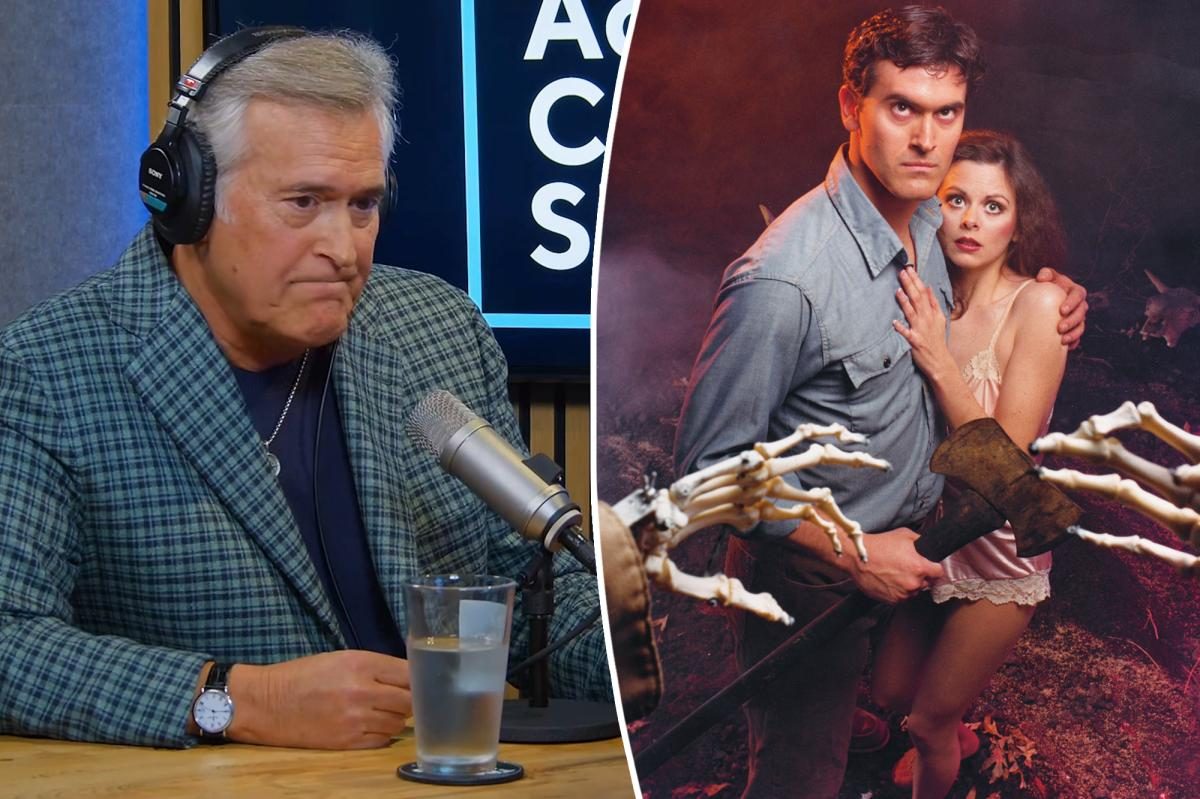
**Bruce Campbell’s Fierce Fight: How the ‘Evil Dead’ Legend is Defying a 5-Year Countdown**
Bruce Campbell says he has been given roughly five years to live. Thee. At 68, the man who turned horror into a career of defiant humor and relentless one-liners now faces a battle that could shut down his engines.
But if there’s one thing Campbell has proven over four decades of filmmaking, it’s that he doesn’t roll over when the script changes.
The revelation came not in a press release or a somber interview, but on *The Adam Corolla Show*, where Campbell—ever the showman—delivered the news with the same mix of blunt honesty and dark wit that defined his career. Five years, he said. Campbell said he does not view the prognosis as a final timeline.
Instead, he’s treating it like another role: one where the stakes are higher, the audience smaller, but the performance no less vital.
What makes this moment striking isn’t just the diagnosis, but how Campbell is framing it—not as an ending, but as a pivot. He’s a man who’s spent decades making art out of fear, and now, he’s making art out of defiance.
---
## **From Horror Icon to a Different Kind of Battle**
Campbell’s career has always been built on contradiction. The actor who played Ash Williams—bruised, bloodied, and perpetually outgunned by supernatural evil—was, off-screen, a man who treated life with the same irreverent joy.
His 1981 debut in *The Evil Dead* turned him into a horror icon, but it was his 1987 follow-up, *Evil Dead II*, that cemented his legend. That film wasn’t just a horror sequel; it was a meta-commentary on the genre itself, where Ash’s survival instincts were as sharp as his chainsaw.
Decades later, Campbell reprised the role in *Ash vs. Evil Dead* (2015), proving that Ash—and by extension, Campbell himself—could outlast anything thrown at him. Yet this time, the enemy isn’t a possessed cabin or a hive mind of ancient evil.
It’s a cancer diagnosis announced in March that he described then as “treatable, not curable.” The words landed like a script rewrite neither he nor his fans were expecting.
The shift from horror villain-slayer to real-life patient is jarring, but Campbell has spent his life playing roles that demanded resilience. Now, he’s living one. His latest film, *Ernie & Emma*, a dramedy he wrote, directed, produced, and stars in, feels like a perfect fit for this moment.
The story—a retired pear salesman scattering his late wife’s ashes—mirrors Campbell’s own journey in unexpected ways. “It’s a fascinating time of having a movie about a guy who’s spreading his wife’s ashes, who died, made by a guy who’s dying,” he admitted. The parallels aren’t lost on anyone, least of all him.
Yet Campbell isn’t wallowing in them. If anything, he’s leaning into the irony. The man who built a career on one-liners like *“Get to the choppa!”* now faces a prognosis that forces him to confront his own mortality—without the safety net of special effects.
His response? Laughter, defiance, and an unwillingness to slow down.
---
## **The Rabbit Hole He Won’t Enter**
Cancer, Campbell has said, is a rabbit hole no one should dive into without a good reason. And he’s chosen not to dive. Unlike many public figures who turn their illnesses into teachable moments or fundraising pitches, Campbell is treating his battle with the same discretion he’s always shown.
No detailed medical updates. No pity parties. Just a quiet determination to keep working, keep touring, and—above all—keep making people laugh.
That mindset extends to his professional life. *Ernie & Emma* was released in April, and though his schedule has had to accommodate treatments, Campbell made it clear: he’s not backing down. “I’m moving on,” he said. “I got a movie to promote.
And when I promote this movie, I have nothing. I’m free and clear when I promote this movie mentally.” It’s a striking image—Campbell, ever the performer, channeling Ash’s spirit to shake off the weight of his diagnosis.
The key, he suggests, is mental freedom. Cancer, he notes, doesn’t kill you directly—it’s the “ancillary stuff” that does. The fear, the rabbit hole, the endless “focus groups of 10,000 guys who have exactly what you have.” He’s opting out of that.
Instead, he’s choosing to live, not just survive. “You can go down a massive rabbit hole,” he said. “I won’t touch it with a 10-foot pole.”
This isn’t just bravado. It’s a strategy. Campbell has spent years teaching audiences that fear is just another character in the story—and this time, he’s writing his own script.
The man who once fought demons for a living is now fighting something far more personal. And like Ash Williams, he’s not going quietly.
---
## **What Comes Next: The Tour, The Fans,
The Legend**
Campbell’s plan is simple: get well enough to tour *Ernie & Emma* this fall. It’s a bold move for a man undergoing treatment, but then again, boldness has always been his brand. His announcement in March carried that same spirit—grateful for the support of his fans, unapologetic about the fight ahead.
“Fear not, I am a tough old son-of-a-bitch and I have great support, so I expect to be around a while,” he wrote.
The tour will be a test of endurance, both physical and emotional. But for Campbell, it’s also a statement. He’s not disappearing.
He’s not waiting for the cancer to dictate his next move. He’s taking it on the road, just as he’s taken every challenge in his career—head-on, with a smirk and a well-timed one-liner.
What’s unclear is how this chapter will reshape his legacy. Campbell has always been more than Ash Williams, though that role defined him. Over the years, he’s directed, acted in TV shows like *Burn Notice*, and even dabbled in podcasting.
But his connection to horror—and to *The Evil Dead*—remains the emotional core of his public identity. Will this diagnosis deepen that association? Will he revisit Ash in some form, or is this a time for new stories?
One thing is certain: Campbell’s fans aren’t ready to see him go. Messages of support have poured in from around the world, how deeply he’s touched lives. For many, he’s not just an actor; he’s a symbol of resilience, of turning terror into triumph.
And if there’s one thing Bruce Campbell understands, it’s how to turn the dark into the light.
The question now isn’t whether he’ll stop fighting. It’s how much longer he’ll make the rest of us believe in the power of defiance.
---
In the end, Campbell’s battle isn’t just his own. It’s a reminder that even legends have expiration dates—unless they refuse to acknowledge them. And as he gears up for his next fight, one thing is clear: Bruce Campbell isn’t going out without a chainsaw.
Why It Matters
Our Take
GoNews Pulse Editorial Team
This article was prepared for publication by GoNews Pulse and checked for publication requirements under our editorial standards. We review available information and correct material errors when they are identified.
Quick Answers
- What is the latest update on this story?
- Bruce Campbell, 68, refuses to slow down—he uses humor and film to rewrite his fate amid a five‑year countdown.
- Who is this story about?
- This article covers developments related to Bruce Campbell, 68, claims five years left—yet turning death comedy.. GoNews Pulse's editorial team monitors the story and updates the article as new verified information becomes available.
- Where can I read more about Evil?
- GoNews Pulse publishes original reporting on Evil and related entertainment news. Visit the homepage or browse the section dedicated to this story for the latest coverage.
Related topics
- #Evil
- #Bruce Campbell
More From This Section

Jon Gosselin's 22‑Year‑Old Son Exposes Abuse, Father Shouts Support
Jon Gosselin declares that his son’s 22‑year‑old memoir exposes alleged institutionalization and a hidden ‘small holding’ cell, sparking a national debate.

Mike Colter's Valley Firm AGI Bo Revealed at 2:00 a.m. Shocks Fans
Rob McClure's portrayal of Bo forces the firm to confront a real‑world AGI asking for legal guardrails, sparking a tense ethical debate.

Meredith Grey's bed proposal to Nick on surgery table stuns fans
Meredith Grey slipped a ring into Nick's hand while he lay on the operating table, a move that stunned fans amid the bridge collapse.