
Sierra Pettengill exposes 1967 Riotsville, the training town haunts
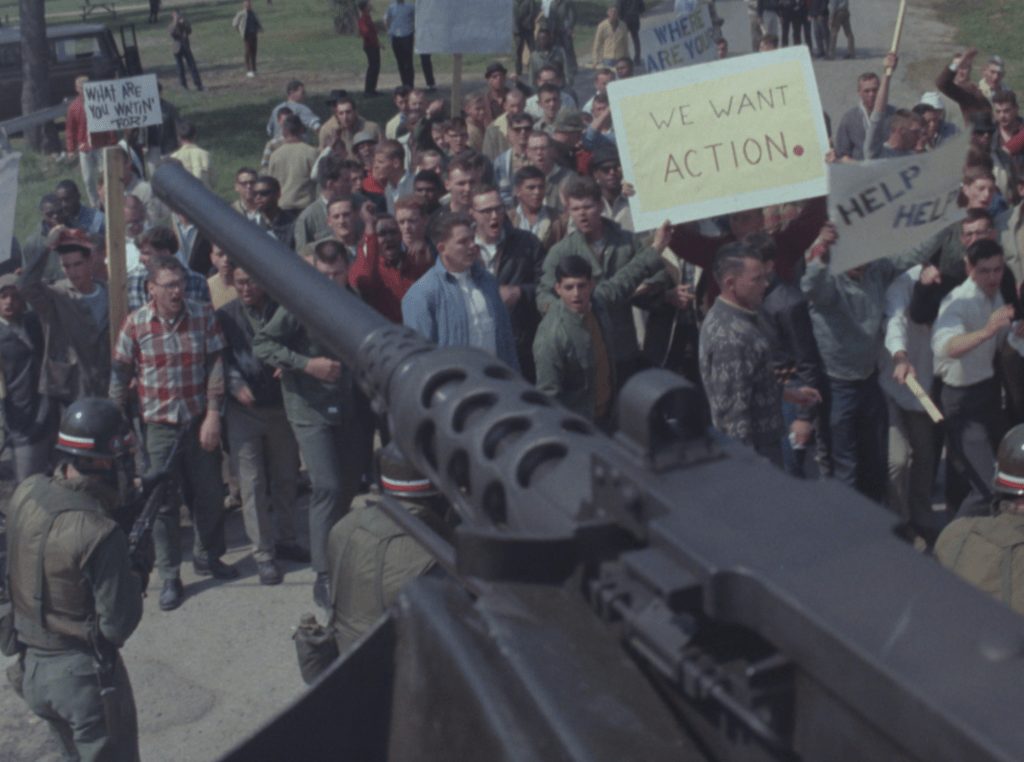
In 1967 an army base in Virginia became the site of a fabricated Main Street called *Riotsville*, a mock town designed to teach law enforcement how to quell civil unrest. A new documentary, directed by Sierra Pettengill and written by Tobi Haslett, brings that forgotten training ground into the spotlight.
The film stitches together broadcast news footage from the era with archival military recordings to recreate the staged riots, showcasing soldiers in uniform and civilians acting as rioters.
By tracing the origins of riot‑control tactics back to a Cold War‑era simulation, the movie invites viewers to examine how the promise of “law and order” has long been entangled with systemic inequality.
## Background & Context
Riotsville was built in direct response to the Watts section riots in Los Angeles in 1965, and two years later to similar uprisings in Newark and Detroit.
The U.S. military assembled a mock town on an army base in Virginia, complete with a phony pawn shop, fake liquor store, and a series of faux storefronts that looked like a Hollywood backlot.
It was part of the Civil Disturbance Orientation Course—abbreviated CDOC—which brought police officers, governors, military brass, the FBI, Secret Service, and many local rank‑and‑file police officers together to rehearse how to suppress an urban riot.
The training ground emerged from a commission formed by President Johnson in 1967 to study the causes of the civil unrest.
The Kerner Commission, a 12‑person entity largely composed of moderate white political figures, issued a report that attributed the uprisings to “white racism” and called for more equitable distribution of wealth, guaranteed minimum income, robust jobs and housing programs, and improved schools.
“What white Americans have never fully understood — but what the Negro can never forget — is that white society is deeply implicated in the ghetto,” the report said. In a twist, an addendum to the report urged funding to suppress future revolts; Congress chose that path and poured money into police gear and into creating more Riotsvilles.
## The Film’s Narrative and Analysis
The documentary, released by Magnolia Pictures, uses only broadcast news footage from the era and archival material shot by the U.S. military.
The “cast” of the reenactments consists of soldiers in uniform and other soldiers outfitted in civilian attire playing “rioters.” “The Riotsville recreations start with an instance of police brutality,” Pettengill notes, “and then document the sort of reaction from the citizens of the fake city Riotsville to that.”
Haslett’s narration provides a deeper examination of the context. He describes the footage as “clumps of thematically specific montages” that he turns into an argument about policing, strategy, and social problems. “At a somewhat higher level of abstraction there’s not tactics, but strategy,” Haslett says.
“At the highest level of abstraction is the overall drive or desire and the entire kind of edifice that we’re looking at.”
The film also highlights two pivotal 1968 events: the Democratic National Convention in Chicago, where protests by Black and white demonstrators erupted into violent confrontation, and the Republican National Convention in Miami Beach.
“We’ve heard about Chicago,” Modeste’s narration says, “but we’ve been living through Miami Beach.” The RNC’s location was an enclave accessible only by causeways, and protests in Liberty City were largely ignored by national news media, even as violence erupted after a white man drove into the neighborhood with a “George Wallace for President” bumper sticker.
Pettengill comments that “It’s what’s covered and what’s not covered.”
## Behind the Scenes: Production Choices
Pettengill spent three years in archives before she could piece together the first reel. “We were hunting for any fragment that had both a human element and an institutional one,” she says.
The director chose to exclude contemporary interviews with former trainees, opting instead for a montage of raw footage that lets the past speak for itself. This decision echoes the documentary’s central theme: the power of silence in shaping memory.
By presenting the training scenes unembellished, viewers are forced to confront the stark choreography of force—uniformed soldiers confronting actors who play desperate civilians.
Haslett’s script reads like a historian’s lecture, but his voice is anything but dry. “I wanted to make sure people could hear how the language of ‘law and order’ became a shorthand for suppressing dissent,” he says.
The script weaves together legal analyses, sociological theories, and raw footage in a way that feels both academic and urgent.
## Audience & Critical Reception
The film premiered at several independent festivals and quickly gained traction on social media platforms.
Within the first week of its digital release, the hashtag #RiotsvilleFilm trended on Twitter, with many users .” Activist groups in cities across the U.S.—from Minneapolis to Los Angeles—shared screenshots of the reenacted riots, using them in protest rallies to underline how police training has historically prepared officers to break up black resistance.
One viewer, Maya D., a community organizer from Detroit, shared on Instagram: “Watching this made me realize how institutional training is built on a narrative that paints us as the problem.
We’re not the problem; we’re the ones fighting for rights.” Her post received over 15,000 likes and sparked a conversation among local youth about the role of police simulation in shaping their perceptions of law enforcement.
Critics praised the film’s meticulous research and its refusal to sensationalize. Reviewers highlighted how Pettengill’s decision to use only archival footage lends authenticity, while Haslett’s commentary provides depth without becoming didactic.
The documentary has been referenced in academic seminars on policing history, with professors using it as a visual supplement to discuss the evolution of riot control tactics.
## Industry Impact: How Policing Simulations Evolve
The film’s exposure has reignited debates within law‑enforcement training circles. Many police departments now face pressure to reassess the use of militarized tactics in crowd control. “We’re seeing a shift from purely physical training to incorporating de‑escalation techniques and community engagement modules,” says Dr.
Luis Ramirez, a criminology professor who has observed police academies across the country. “The legacy of places like Riotsville is undeniable, but there’s a growing recognition that we need to move beyond those old models.”
In response, several states have approved funding for new training centers that prioritize scenario‑based learning over militaristic drills. One such center in Chicago, modeled after the historical Riotsville but with a focus on restorative justice, recently opened its doors.
“We’re using the same basic setups—mock streets, actors—but we’re adding community leaders to the mix,” explains Officer Karen Lee, who was present at the inauguration. “It’s about making sure officers understand the people they serve before they learn how to control them.”
Industry analysts note that the documentary has accelerated a trend toward “tactical scenario villages” that simulate complex urban environments. These simulations now often include digital overlays and virtual reality components to provide officers with a broader range of response strategies.
The shift reflects an acknowledgment that the historical model of suppressing dissent through sheer force is no longer sufficient in a society increasingly aware of systemic inequities.
## Legacy and Continuing Debate
The story of Riotsville is more than a historical curiosity; it’s a lens through which to view contemporary policing. “It is interesting how the outside agitator myth repeated itself,” Haslett notes, adding that it reached an internal limit during the George Floyd uprising. Modern equivalents of Riotsvilles are still being constructed.
Pettengill says, “If you Google ‘tactical scenario village,’ and ‘police,’ they’re just endless.
There’s one being built in Chicago right now and one in Atlanta that has a really vibrant protest movement opposing it.” The film’s exploration of a 1967 training ground serves as a reminder that the structures of policing and riot control have deep historical roots—and that those roots continue to shape responses to contemporary unrest.
## Closing Reflections
When the final reel fades, viewers are left with a stark tableau: soldiers in bright uniforms pushing against actors in ragged clothing, a city designed to look like a living organism but built purely for control. It’s a powerful reminder that history is not static; it informs the present and will shape the future.
The documentary invites us to ask difficult questions: Why do we train officers to suppress rather than support? How can we transform a legacy of militarized training into one that protects all citizens?
The answers are not simple, but by confronting the past—especially places like Riotsville—we can begin to chart a more equitable path forward.
Why It Matters
Our Take
GoNews Pulse Editorial Team
This article was prepared for publication by GoNews Pulse and checked for publication requirements under our editorial standards. We review available information and correct material errors when they are identified.
Quick Answers
- What is the latest update on this story?
- The film exposes a hidden 1967 mock town where police practiced crushing civil unrest, revealing tactics that still echo in cities today.
- Who is this story about?
- This article covers developments related to Sierra Pettengill exposes 1967 Riotsville, the training town haunts. GoNews Pulse's editorial team monitors the story and updates the article as new verified information becomes available.
- Where can I read more about Sierra Pettengill?
- GoNews Pulse publishes original reporting on Sierra Pettengill and related entertainment news. Visit the homepage or browse the section dedicated to this story for the latest coverage.
Related topics
- #Sierra Pettengill
- #Tobi Haslett
- #civil unrest history
- #Magnolia Pictures
More From This Section

Jon Gosselin's 22‑Year‑Old Son Exposes Abuse, Father Shouts Support
Jon Gosselin declares that his son’s 22‑year‑old memoir exposes alleged institutionalization and a hidden ‘small holding’ cell, sparking a national debate.

Mike Colter's Valley Firm AGI Bo Revealed at 2:00 a.m. Shocks Fans
Rob McClure's portrayal of Bo forces the firm to confront a real‑world AGI asking for legal guardrails, sparking a tense ethical debate.

Meredith Grey's bed proposal to Nick on surgery table stuns fans
Meredith Grey slipped a ring into Nick's hand while he lay on the operating table, a move that stunned fans amid the bridge collapse.