
Plane flies crude anti‑Ellison banner over Paramount amid merger surge
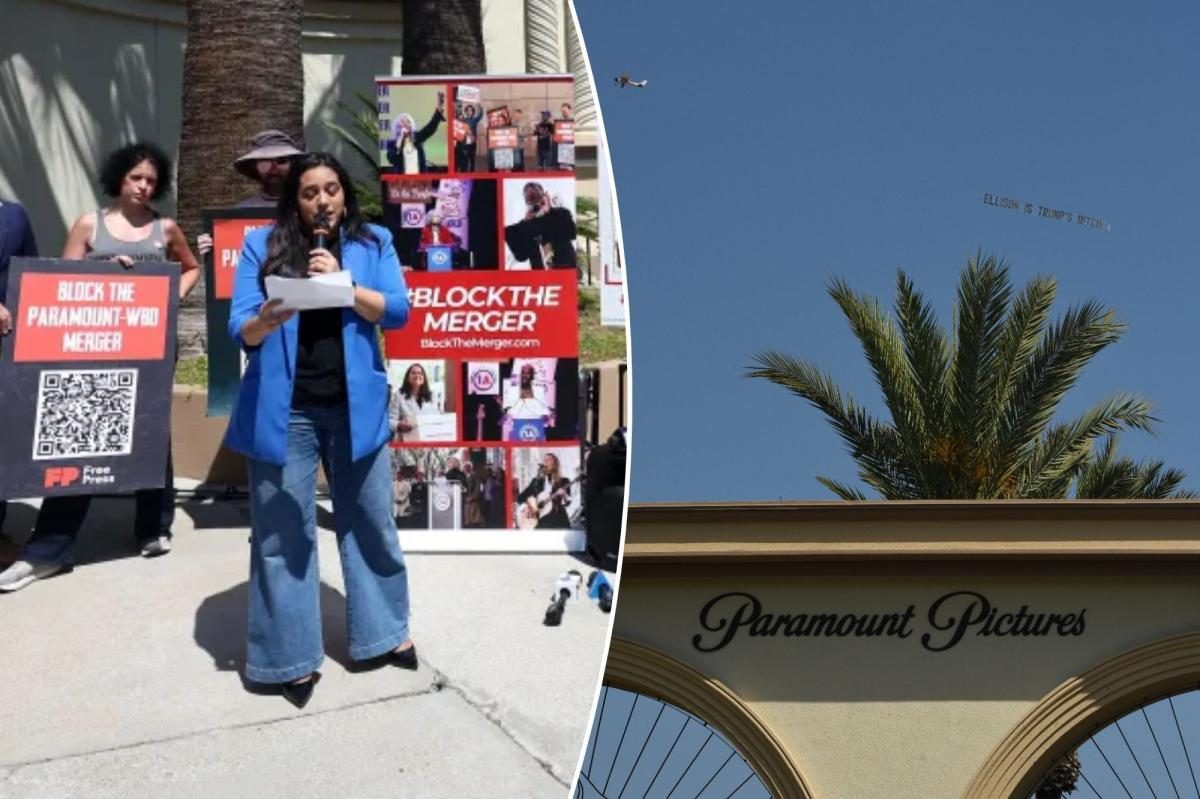
**Plane Circles Paramount With Anti‑CEO Banner While Pro‑Merger and Anti‑Merger Groups Hold Separate Events**
On Thursday morning, a small aircraft flew above Paramount Pictures’ iconic arches on Melrose Avenue, displaying a banner that read “Ellison is Trump’s Bitch.” The same day, two distinct rallies unfolded outside the studio and inside a nearby soundstage, representing opposing sides of the pending Paramount‑Warner Bros merger.
The pro‑merger rally was organized by Neighbors for Strong Communities, while the anti‑merger gathering was led by Free Press. Both groups had already drawn attention from industry workers and local politicians.
The events occurred against the backdrop of California Attorney General Rob Bonta’s antitrust lawsuit, which seeks to block the merger on the grounds that it would reduce competition in the entertainment market and threaten jobs.
## Background & Context
The merger between Paramount Global and Warner Bros Discovery was announced in 2023, sparking regulatory scrutiny across the United States. Attorney General Bonta filed an antitrust lawsuit in July, alleging that the deal would consolidate too much market power and could lead to higher prices for consumers.
The lawsuit is currently pending before state courts and federal regulators.
Neighbors for Strong Communities claims to be a community advocacy group that supports local business stability. The organization has been accused of being a front for the Ellison family, although it denies any connection to Paramount or Warner Bros Discovery.
Prior to Thursday’s rally, the group sent text messages to California residents urging AG Bonta to drop his lawsuit and encouraging a settlement that would allow the merger to proceed.
Free Press is a coalition that positions itself against the merger. The group has no affiliation with Bari Weiss’s media company but is linked to Jane Fonda‑backed Committee for the First Amendment. Their Thursday rally featured about fifteen participants, including actors, comedians, and city council members from Burbank.
Speakers included actress Alyssa Phillips and councilmembers Nikki Perez and Konstantine Anthony.
The roots of the dispute run deeper than the headline drama. Paramount’s acquisition of the remaining stake in its eponymous studio by the Ellison family—famous for co‑founding Oracle—has long been a point of contention among Hollywood insiders.
Critics argue that their influence could tilt creative decisions toward political messaging rather than pure storytelling. In contrast, supporters claim that the Ellison legacy brings capital and stability, allowing the studio to weather an increasingly fragmented streaming landscape.
Historically, Hollywood has seen its share of mega‑mergers: Disney’s purchase of 20th Century Fox in 2019, Sony’s acquisition of Columbia Pictures in 1989, and the recent Warner Bros–HBO merger that preceded this current deal. Each has reshaped the competitive dynamics of film production, distribution, and content ownership.
Stakeholders now weigh whether a Paramount‑Warner Bros union would replicate past successes or create new systemic risks.
## What People Are Saying
Roger Neal, a publicist for Neighbors for Strong Communities, explained that the rally was moved to a BLT Studios soundstage after learning of a planned counter‑rally by Free Press. He said the move was made to avoid confrontation between the two groups. “We wanted to keep it peaceful and focused on our message,” Neal told reporters.
“The studio setting let us control the environment and present our case without noise.” The event at the studio was described as dimly lit and sparsely attended, with close to a dozen Hollywood attendees voicing concerns about Ellison’s alleged threat to leave California.
Industry workers expressed worry about potential job losses. Dani Kelly, owner of a podcast studio in Chatsworth, told an interview that she would have no business if Ellison left the state. “I need people in the industry here,” she said.
“I will have no business.” Her comments reflect broader concerns among entertainment professionals about the economic impact of the merger.
Jessica Gonzalez, co‑CEO of Free Press, stated that her group planned its counter‑event after learning of Neighbors for Strong Communities’ rally. She said the decision was driven by a desire to provide a platform for voices opposing the merger.
“We didn’t want to be silent while big names push something that could harm local creators,” Gonzalez said. The rally’s modest turnout was highlighted as an indication of fatigue among industry workers about the ongoing debate.
Fans of Paramount and Warner Bros productions also weighed in on social media. A popular film‑fan subreddit saw over 1,200 comments within the first hour of the banner’s flight, with memes mocking the political punchline and calls for a “more creative” studio culture.
Twitter threads debated whether the banner was a legitimate form of protest or an inappropriate attack on a private individual. Meanwhile, Instagram users posted photos from the rallies, tagging their favorite actors who appeared to support either side.
The plane banner itself sparked a flurry of speculation. Some observers praised the stunt as a bold stand against perceived political domination in Hollywood. Others criticized it as harassment and defamation, pointing to California’s strict anti‑harassment statutes that could apply.
Legal experts warned that the content might become a point of contention in future court filings, either as evidence of hostility toward corporate leadership or as a demonstration of free‑speech activism.
## The Industry Impact
Beyond the political rhetoric, the merger has tangible implications for the California entertainment ecosystem. Analysts predict that a combined Paramount‑Warner Bros entity could generate annual revenue exceeding $35 billion, but regulators fear that such concentration could stifle smaller studios and independent filmmakers.
“When two giants merge, the marginal cost of entry for indie creators rises,” said a former studio executive who wished to remain anonymous. “We already see a shift toward streaming exclusives, but this would push even more content into paid tiers.”
The potential exit of the Ellison family from California could trigger a chain reaction. The Ellison estate reportedly owns significant real‑estate holdings in Hollywood Hills and Burbank, including soundstages and post‑production facilities.
A departure might force those properties to be sold to outside investors, altering the local economic landscape. the Ellisons have historically supported charitable initiatives in Los Angeles, such as scholarships for film students and community outreach programs; their exit could create funding gaps.
From a workforce perspective, employees fear that consolidation could lead to redundancies in middle‑management roles that overlap between the two studios. Reports from union officials indicate that “over 3,000 staffers across both companies” might be at risk of layoffs if the merger proceeds without concessions.
Conversely, proponents argue that a larger company could offer more stable, long‑term contracts and higher salaries for creative talent.
The fan community also feels the ripple effects. Streaming platforms are already under pressure to secure exclusive rights to blockbuster franchises, and a Paramount‑Warner Bros union could dominate distribution channels. This might limit the reach of niche or genre‑specific content that appeals to dedicated fanbases.
“We love the cult films that smaller studios produce,” said a long‑time fan who has followed indie releases for over a decade. “If one big entity controls everything, we may lose those hidden gems.”
## What Happens Next
The merger remains subject to review by federal and state regulators. If Bonta’s lawsuit is successful, the deal could be blocked or require significant concessions. Paramount Global and Warner Bros Discovery will likely need to address antitrust concerns and may seek court‑ordered hearings to justify the transaction.
The plane banner that flew over Paramount could prompt scrutiny of the public‑relations tactics used by both sides. The legality of the banner, particularly whether it constitutes harassment or defamation, may be considered in future court filings. A review of the content’s impact on business relations is also possible.
Attendance at both rallies was low, suggesting that industry workers are experiencing fatigue from the ongoing merger debate. The next steps may involve further public hearings, new regulatory actions, or additional lobbying efforts by both pro‑merger and anti‑merger groups.
A month after the initial announcement, a coalition of independent filmmakers announced plans to petition the California Legislature for “fair‑competition” legislation that would cap the number of studios a single entity could own in key markets.
The proposal has already garnered support from over 30 000 industry professionals and several civic leaders. “We’re not against growth; we’re against monopolistic control,” said a spokesperson for the coalition.
The unfolding events underscore the complexity of the Paramount‑Warner Bros merger and its implications for the entertainment industry in California.
The outcome will depend on legal challenges, regulatory reviews, and the continued engagement of stakeholders across the sector— from studio executives and lawmakers to fans who keep these stories alive on screen.
Why It Matters
Our Take
GoNews Pulse Editorial Team
This article was prepared for publication by GoNews Pulse and checked for publication requirements under our editorial standards. We review available information and correct material errors when they are identified.
Quick Answers
- What is the latest update on this story?
- A plane’s crude anti‑Ellison banner rockets over Paramount as the anti‑merger crowd swells in Los Angeles.
- Who is this story about?
- This article covers developments related to Plane flies crude anti‑Ellison banner over Paramount amid merger surge. GoNews Pulse's editorial team monitors the story and updates the article as new verified information becomes available.
- Where can I read more about Paramount Pictures?
- GoNews Pulse publishes original reporting on Paramount Pictures and related entertainment news. Visit the homepage or browse the section dedicated to this story for the latest coverage.
Related topics
- #Paramount Pictures
- #Warner Bros Discovery
- #Ellison family
- #Free Press coalition
More From This Section

Jon Gosselin's 22‑Year‑Old Son Exposes Abuse, Father Shouts Support
Jon Gosselin declares that his son’s 22‑year‑old memoir exposes alleged institutionalization and a hidden ‘small holding’ cell, sparking a national debate.

Mike Colter's Valley Firm AGI Bo Revealed at 2:00 a.m. Shocks Fans
Rob McClure's portrayal of Bo forces the firm to confront a real‑world AGI asking for legal guardrails, sparking a tense ethical debate.

Meredith Grey's bed proposal to Nick on surgery table stuns fans
Meredith Grey slipped a ring into Nick's hand while he lay on the operating table, a move that stunned fans amid the bridge collapse.